My daughter, who’s been getting curious about how evolution shaped all the animals on Earth, including us, recently asked me if humans are still evolving. I thought the answer was no.
For most of life’s history, organisms with traits that reduced the likelihood of successful reproduction were less likely to pass on their genes, so those traits eventually disappeared from the gene pool. Traits that improved survival or reproduction became more common in offspring, gradually shaping the species. For billions of years, this kind of “selective death” was the main driver of evolution.
Today, things are different. Medical care and technology mean that many people who might not have survived or reproduced in the past can now do so successfully. Conditions that once limited survival or mating (poor eyesight, physical disabilities, chronic illness) don’t necessarily prevent people from having children anymore.
So, I thought, maybe humans aren’t really evolving anymore. But after digging a bit deeper, I realized that was only partly true. Natural selection through survival has indeed weakened, but evolution doesn’t stop there. Other pressures are still shaping our species.
What’s Shaping Us?
While the human gene pool is no longer driven mainly by who lives or dies before reproducing, it is influenced by who reproduces more. And people don’t all reproduce at the same rate. What factors contribute to who makes the most babies?
- Cultural and economic influences
Family size differs across regions and communities, which changes the balance of genes over generations.
Example: In many industrialized countries, highly educated women tend to have fewer children. Meanwhile, communities that culturally emphasize large families may pass their genes on at higher rates. Over centuries, this could shift the global gene pool toward traits associated with high-fertility groups. - Sexual selection
Partner preferences, for attractiveness, health, intelligence, or personality traits, still influence whose genes get passed on.
Example: Taller men are often considered more attractive, and in some societies, they also tend to have more children. If that preference holds across generations, genes for taller height may continue to spread. - Disease resistance
Genes that helped people survive pandemics like COVID-19, or historical killers like malaria or plague, can persist and spread.
Example: The sickle-cell trait, while dangerous in its homozygous form, persists in parts of Africa because it offers resistance to malaria. Similarly, a mutation called CCR5-Δ32 in some Europeans provides resistance to HIV, a relatively recent example of disease shaping gene frequencies. - Random mutations and drift
Mutations continue to randomly occur. If they aren’t harmful, they can spread by chance.
Example: Lactose tolerance arose independently in Europe and Africa within the last ~10,000 years, likely because people who could digest milk had a survival edge when dairy became a food source. Blue eyes, on the other hand, don’t provide much advantage but spread through genetic drift and mate preference. They’re now common in Northern Europe despite starting as a single mutation.
Where is This Going?
So evolution is still happening. But given current trends, how might humans actually change over time? Here are some possibilities:
- Bodies
Warmer climates tend to favor leaner builds. If global warming continues, slim physiques might become both biologically advantageous and more attractive. Current preferences for taller partners may also push things in that direction. - Hair
As clothing and technology replace the insulating role of body hair, we may keep trending toward smoother, hairless skin. Hair in any form could eventually become unattractive. - Vision
We spend more and more time indoors and in darker, screen-heavy environments. Over time, larger or differently adapted eyes could spread. - Jaws and teeth
Since our days of grinding raw plants and tearing raw meat with our teeth are long gone, our mouth parts may continue to shrink as food becomes easier to chew and process. - Vanishing parts
Organs and features with little utility, like wisdom teeth or the appendix, might shrink or disappear in some populations. - Brains
Wild card. Maybe they grow because new demands favor more cognition, or maybe they shrink because we’ve outsourced the tedious and calorie-intensive process of thought to external machines and AI. Who knows. - Immunity
If pandemics remain common, and our bodies continue to be responsible for frontline defense, genes for stronger immune systems could spread.
Looking Ahead
Then I started thinking… If humans are indeed evolving, what might we look like in a million years (if some sort of existential threat doesn’t wipe us out first)? AI can help with that, but with a nightmare fuel warning in advance… This is where things get REALLY freaky.
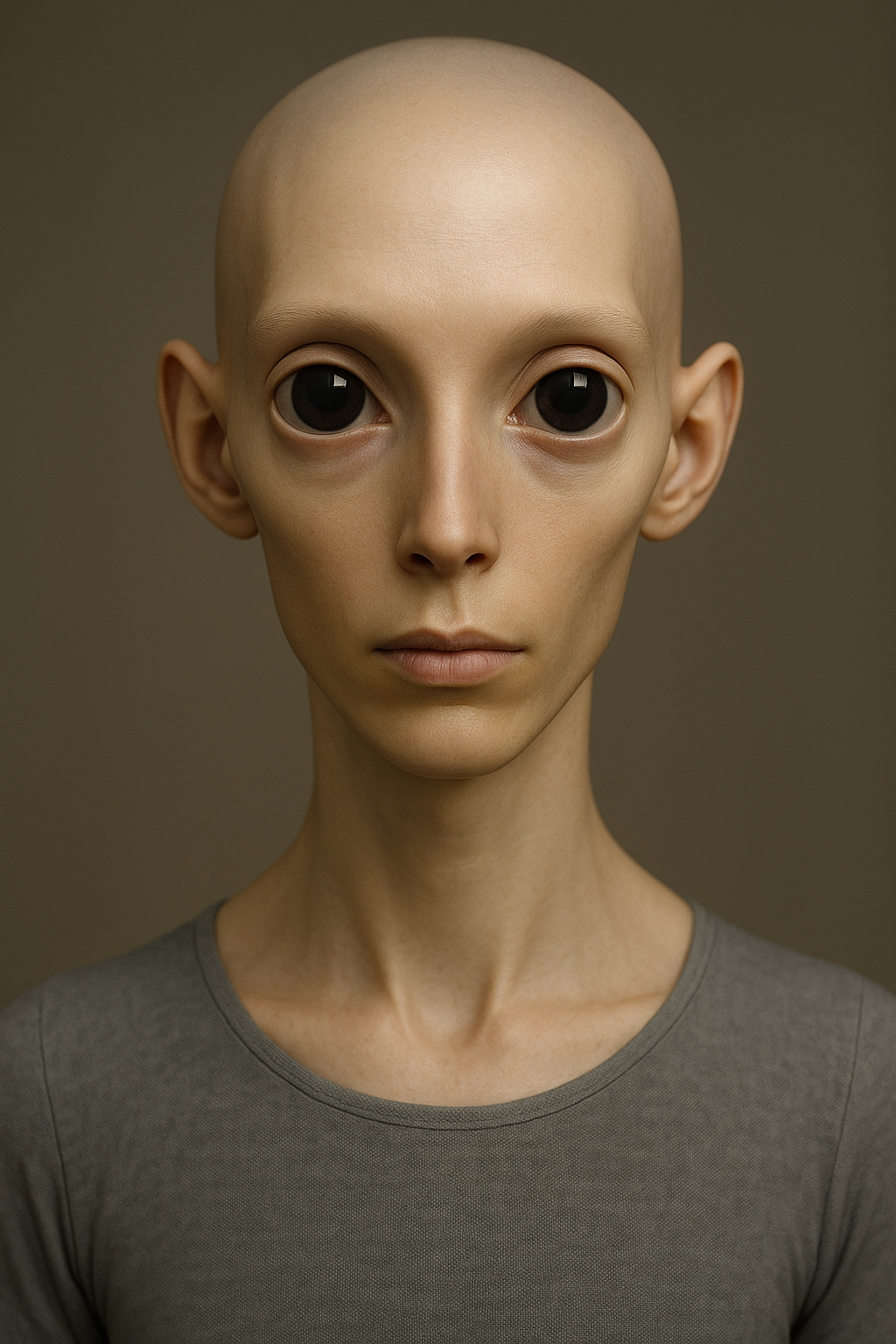
Well that’s disturbing. Our eyes get bigger and more dilated, and we go hairless.
Let’s keep going. If the trends continue, how might humans look after another million years?
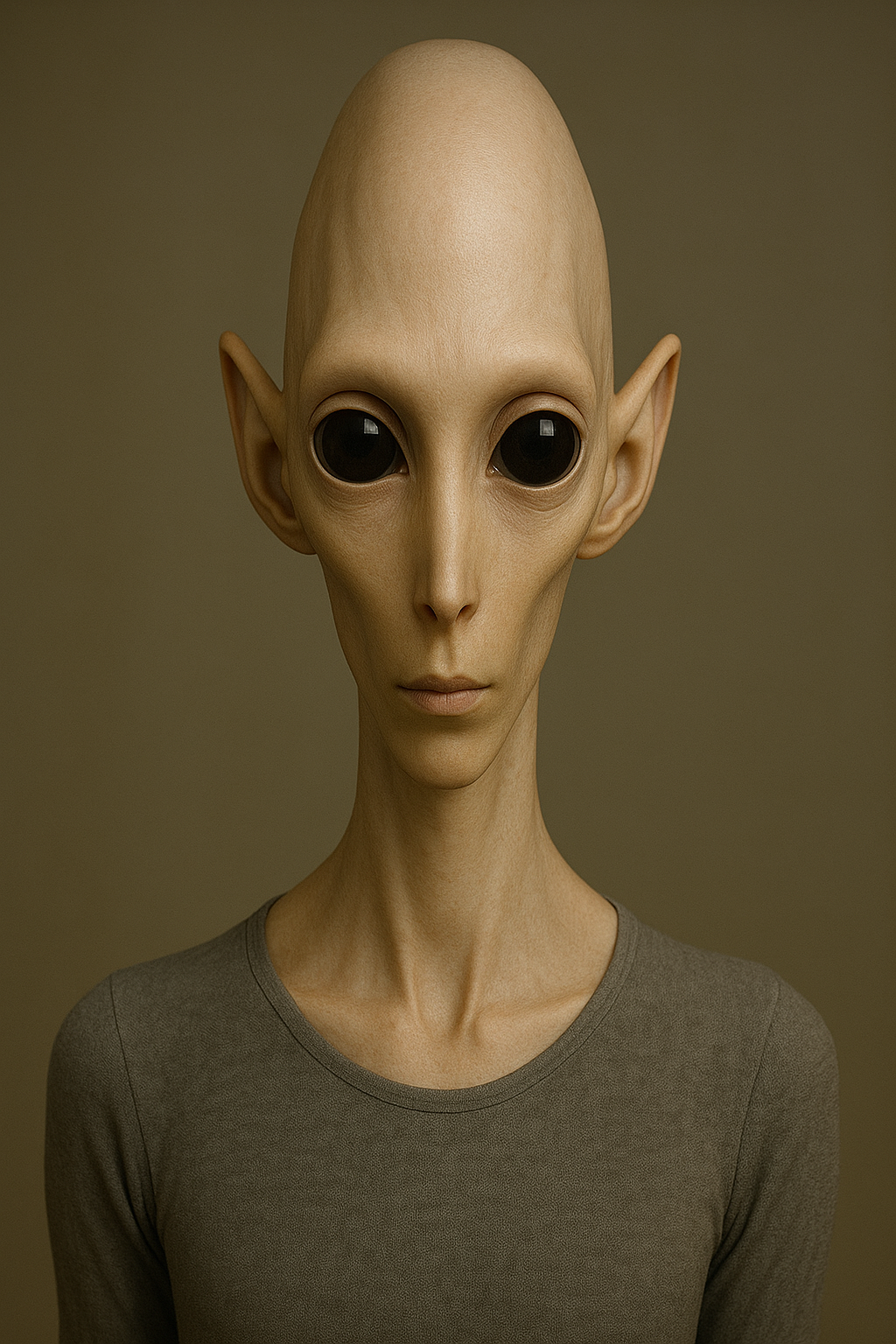
Yikes. Eyes getting even larger, bodies thinner and more fragile-looking.
OK, now let’s go crazy. How about 10 million years after that?
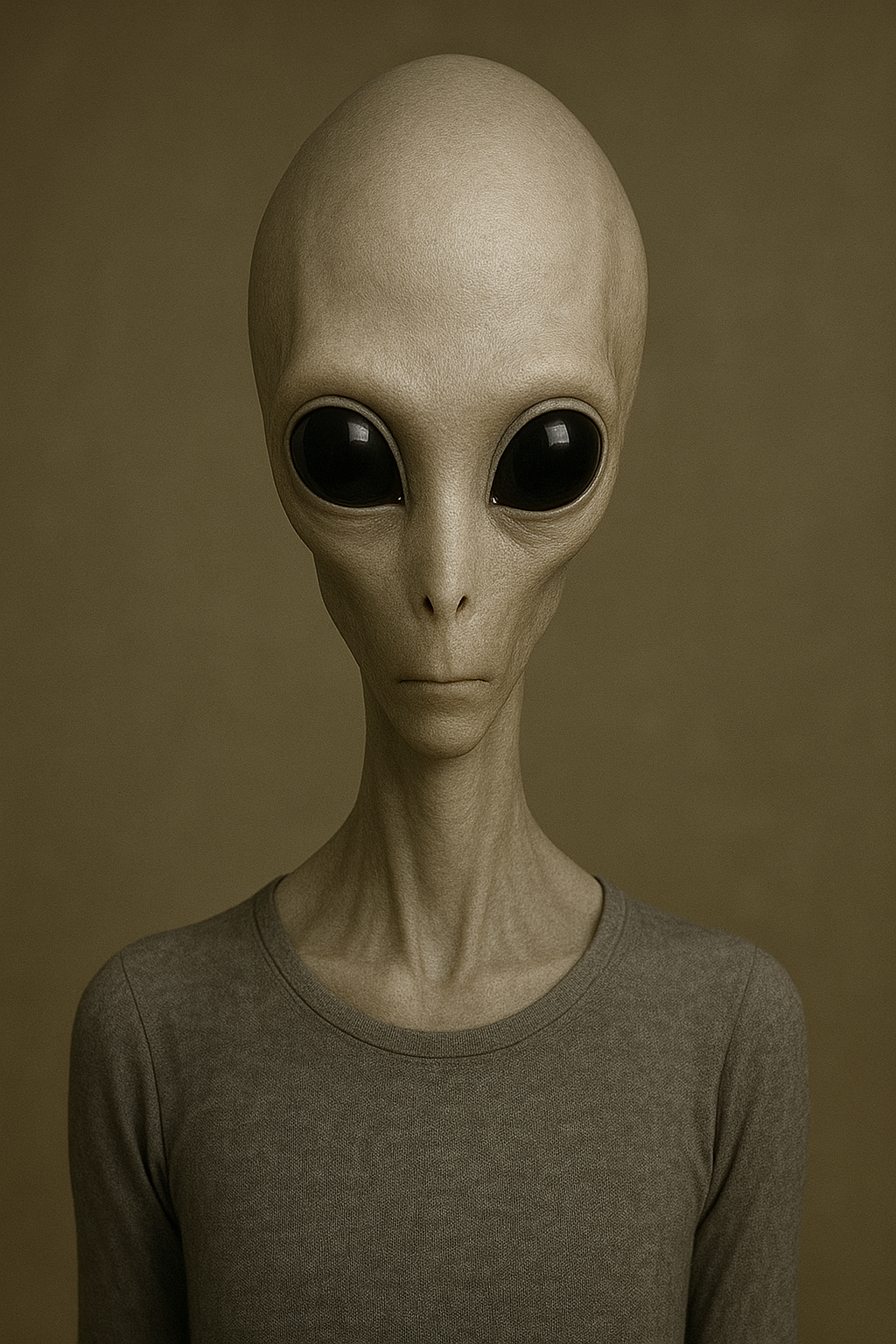
Hold on a minute. Is it any coincidence that these future humans look a lot like the “grey” aliens of science fiction and UFO reports? Nope.
Why Do We Look Like Aliens?
Sci-fi artists and alien storytellers have often asked, “What might intelligent life look like?” Their answer usually starts with what they know, humans, but imagining them as more advanced and more refined, with bigger brains and evolved away from primal bodies that had previously evolved for brute survival in a pre-technological society. And maybe they’re right. In any case, this look has become the shared template for “aliens” in pop culture, and UFO accounts may even have borrowed from it, consciously or not.
So… maybe this IS what our descendants will look like. Weird.
0 Comments